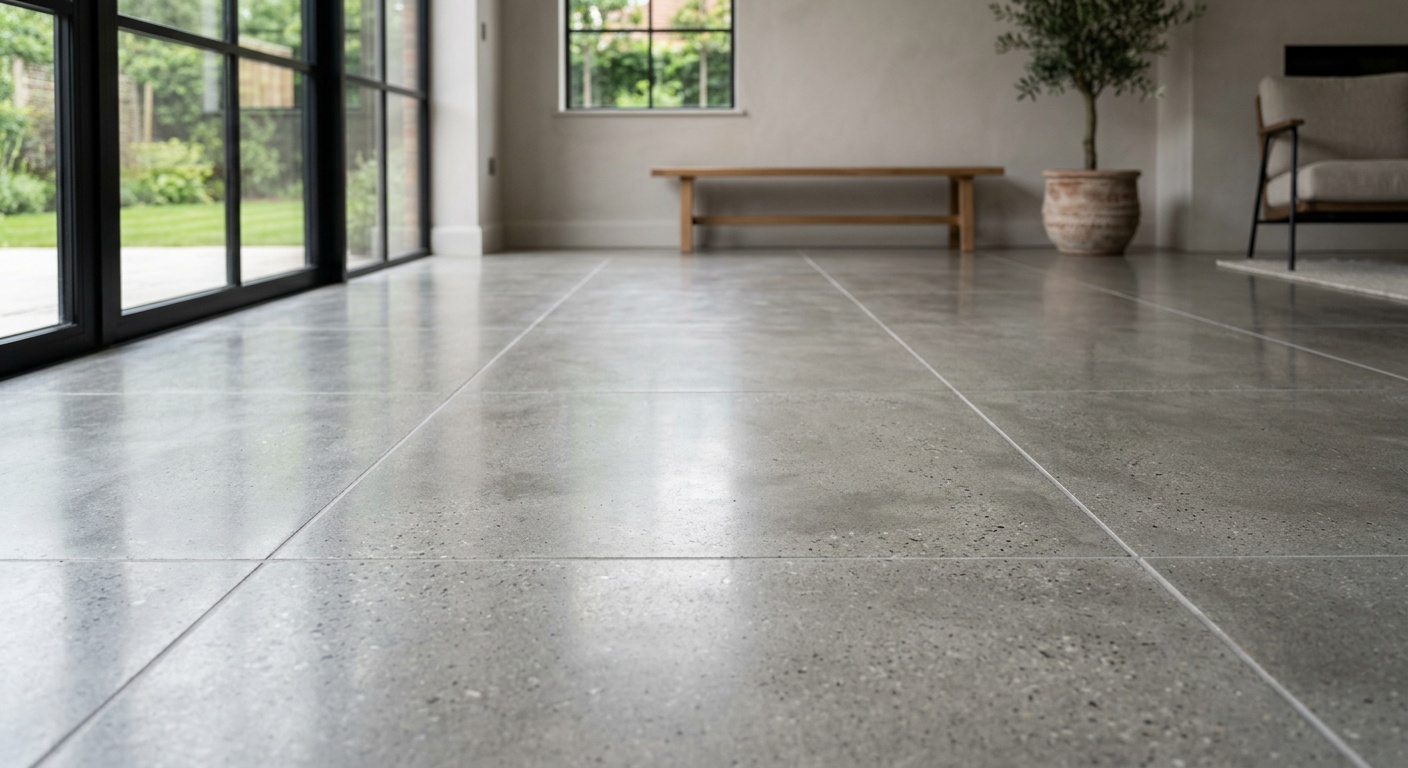
Sunroom Flooring Options: Tile vs. Polished Concrete — The Definitive 2026 Guide
Reading time: 12 minutes
You’ve finally decided to upgrade your sunroom — maybe it’s that aging vinyl that’s peeling at the corners, or perhaps you’re starting from scratch on a brand-new addition. Either way, you’re staring down two of the most popular and practical choices in modern sunroom design: tile and polished concrete. Both are stunning. Both are durable. Both have passionate advocates. But which one is actually right for your sunroom?
Here’s the straight talk: choosing sunroom flooring isn’t just about aesthetics — it’s about understanding how your space behaves across seasons, how much foot traffic it handles, and frankly, how much maintenance you’re realistically willing to commit to. Let’s cut through the noise and give you a clear, honest breakdown.
Table of Contents
- Why Sunroom Flooring Is a High-Stakes Decision
- Tile Flooring: A Deep Dive
- Polished Concrete: A Deep Dive
- Head-to-Head Comparison Table
- Performance Ratings Visualization
- Real-World Case Studies
- Common Challenges and How to Overcome Them
- Frequently Asked Questions
- Your Sunroom Flooring Roadmap: Final Steps
Why Sunroom Flooring Is a High-Stakes Decision
Sunrooms occupy a unique architectural position in any home. They’re simultaneously interior and exterior spaces — subject to temperature swings, UV exposure, humidity changes, and the occasional muddy boot from the garden. According to the National Association of Home Builders (NAHB), as of 2026, sunroom additions rank among the top five home improvement projects that deliver measurable ROI, with average returns of 47–55% of installation cost at resale.
But here’s where many homeowners go wrong: they treat sunroom flooring like any standard interior floor. They don’t account for the thermal cycling — those temperature fluctuations that can cause materials to expand and contract dramatically — or the intense UV bombardment that fades and degrades sensitive materials over time. The wrong floor choice can mean cracked tiles, warped boards, or a polished surface that turns chalky within two seasons.
The two materials we’re examining today — ceramic/porcelain tile and polished concrete — both handle these environmental stressors well. But they do so in fundamentally different ways, with different costs, installation complexities, and long-term maintenance profiles.
“In 2026, we’re seeing homeowners increasingly treat sunrooms as true living extensions rather than transitional spaces. That shift demands flooring that can genuinely perform at both aesthetic and functional levels.” — Sarah Mendenhall, Interior Design Lead at Houzz Pro Network, 2026
Tile Flooring: A Deep Dive
Types of Tile Best Suited for Sunrooms
Not all tile is created equal, and this is especially true in sunroom applications. Your primary options in 2026 fall into three categories:
- Porcelain tile: The gold standard for sunrooms. Fired at higher temperatures than ceramic, porcelain has a water absorption rate of less than 0.5%, making it virtually impervious to moisture damage. It handles freeze-thaw cycles well, which is critical in sunrooms with large glass panels.
- Ceramic tile: A budget-friendly alternative with good performance in climate-controlled sunrooms. Less suitable for three-season rooms exposed to extreme cold or heat without HVAC.
- Large-format porcelain slabs: The trendy option of the moment in 2026. Formats like 24″x48″ or even 48″x48″ create a sleek, minimal-grout-line aesthetic that photographs beautifully and feels spacious underfoot.
The Practical Reality of Tile in Sunrooms
Tile’s greatest strength is also its most complex challenge: it’s cold. In a sunroom that receives winter sunlight through energy-efficient glazing, that cold floor can be genuinely uncomfortable in the mornings. The good news? Radiant in-floor heating pairs exceptionally well with tile, as tile’s thermal conductivity makes it one of the most efficient materials for hydronic or electric radiant systems.
Installation costs for quality porcelain tile in a sunroom context range from $8–$18 per square foot installed as of early 2026, depending on tile size, pattern complexity, and regional labor rates. Large-format slabs trend toward the higher end due to the skill required in leveling and cutting.
Grout lines remain tile’s Achilles’ heel in many homeowner’s minds. In high-traffic sunrooms, grout can stain, crack, and become a cleaning headache. The practical solutions in 2026 include:
- Using epoxy grout, which resists staining and doesn’t require sealing
- Choosing large-format tiles to minimize grout line frequency
- Selecting matching or tone-on-tone grout that hides staining patterns naturally
Slip resistance is another key metric. In sunrooms where wet feet, spilled drinks, and tracked-in rain are realities, look for tiles rated R10 or R11 on the German DIN 51130 slip resistance scale. Many premium brands now include this rating prominently in their product specifications.
Tile Lifespan and Durability
Properly installed porcelain tile in a sunroom setting can realistically last 40–50 years or more. The tile itself rarely fails — it’s the substrate, grout, and installation quality that determine longevity. In 2025, Consumer Reports updated its flooring durability rankings, placing porcelain tile at the top for both sunroom and bathroom applications, noting that 92% of surveyed homeowners rated their porcelain tile flooring as “still in good or excellent condition” after 15 years.
Polished Concrete: A Deep Dive
Understanding the Polished Concrete Process
Polished concrete isn’t just “gray concrete that someone buffed.” It’s a multi-stage mechanical process involving diamond-impregnated grinding wheels that progressively refine the surface from rough aggregate to a mirror-like finish. The process typically involves 6–10 passes with increasingly fine grit levels, from 30-grit coarse grinding up to 3,000-grit final polishing.
In sunroom applications, you’re typically working with one of two scenarios:
- Existing concrete slab: If your sunroom was built on a concrete foundation, you may already have the substrate. The question is whether it’s in good enough condition (no major cracks, minimal pitting) to be polished.
- New pour for a new sunroom addition: This gives you the most control, allowing you to specify aggregate types, integral color, and surface finish level from the ground up.
Aesthetic Versatility and Modern Customization
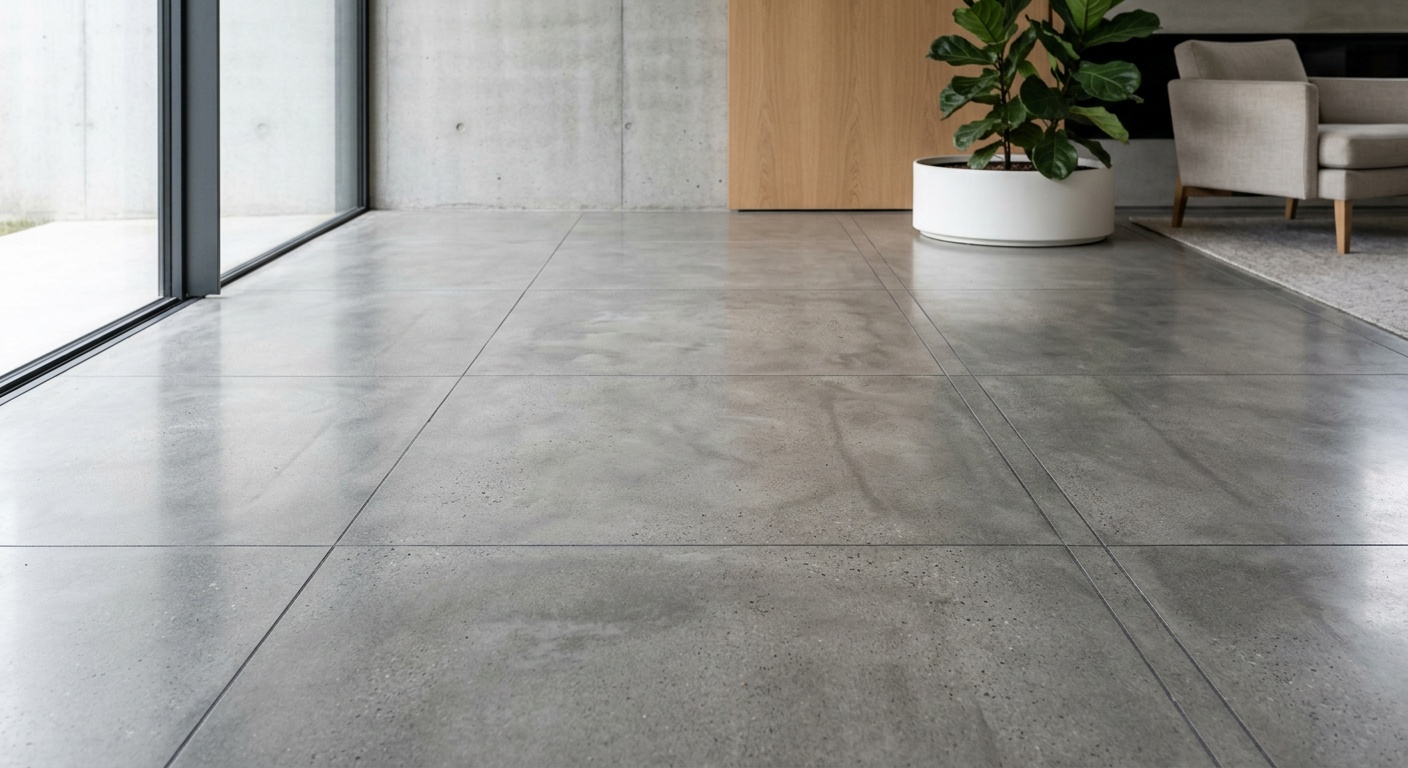
Here’s something that surprises most people new to polished concrete: the range of aesthetic outcomes is enormous. By 2026, advances in concrete staining, dyeing, and aggregate specification mean you can achieve looks that range from industrial-cool charcoal to warm terracotta, from the speckled look of exposed aggregate to the smooth elegance of a fully-cream-finished surface.
Popular 2026 trends in polished concrete for sunrooms include:
- Acid-stained concrete with warm amber and sienna tones that complement natural wood furniture
- White or light-gray polished surfaces that maximize light reflection in north-facing sunrooms
- Saw-cut geometric patterns that add visual interest without requiring tile installation
- Micro-topping overlays over existing surfaces that achieve the polished concrete look without a full grind-and-polish process
Installation costs for polished concrete in sunroom applications typically range from $5–$15 per square foot for grinding and polishing an existing slab, or $10–$25 per square foot for new pours with specialized finishes. The lower end of the existing-slab range is a genuine cost advantage over tile for homeowners who already have a suitable concrete substrate.
Thermal Mass: Polished Concrete’s Secret Weapon
For passive solar enthusiasts and energy-conscious homeowners, polished concrete offers a compelling advantage: thermal mass. A concrete slab absorbs solar energy during daylight hours and releases it slowly as evening temperatures drop — a phenomenon that can meaningfully reduce heating loads in sunrooms designed with southern or southeastern exposure.
A 2025 study by the Building Science Corporation found that sunrooms with polished concrete floors and adequate southern glazing saw 18–24% lower supplemental heating costs compared to equivalent rooms with tile or wood flooring during winter months, attributing the difference primarily to thermal mass performance.
Head-to-Head Comparison Table
| Metric | Porcelain Tile | Polished Concrete |
|---|---|---|
| Installed Cost (2026 avg.) | $8–$18 / sq ft | $5–$25 / sq ft |
| Estimated Lifespan | 40–50+ years | 25–40 years (with maintenance) |
| Maintenance Level | Low–Medium (grout care) | Low (re-seal every 2–5 yrs) |
| Thermal Performance | Good (pairs w/ radiant heat) | Excellent (passive solar mass) |
| DIY Potential | Medium (skilled DIY possible) | Low (professional equipment needed) |
Performance Ratings Visualization
The chart below represents composite performance scores (out of 100) across key sunroom flooring criteria, based on aggregated contractor and homeowner data compiled by the Flooring Contractors Association of North America in their 2025 annual survey.
Real-World Case Studies
Case Study 1: The Minneapolis Sunroom Renovation (2025)
Jenny and Marcus P., a couple in the Minneapolis suburb of Edina, Minnesota, tackled a full sunroom renovation in spring 2025. Their three-season sunroom (no HVAC) was 280 square feet with a southwest exposure — perfect for afternoon sun but notoriously cold from November through March.
They chose large-format porcelain tile (24″x24″) in a warm greige tone with an R11 slip rating and paired it with a 120V electric radiant heat mat beneath the tile. Total flooring installation cost: approximately $5,400, including the radiant mat system. Their tile installer, contracted through a local Minneapolis flooring company, used a decoupling membrane (Schluter Ditra) between the slab and tile to manage thermal expansion — a critical step in Minnesota’s climate extremes.
By winter 2025–2026, Jenny reported: “The floor is genuinely warm by 7 AM when the radiant kicks on at 6. We went from never using the sunroom in winter to having breakfast there every day. The tile looks incredible and we’ve had zero cracking.” Their energy monitoring app showed the radiant system added roughly $18–$22/month to winter electricity bills — a cost they considered entirely worthwhile.
Case Study 2: The Austin New-Build Sunroom (2025–2026)
Designer Priya S. completed a new sunroom addition on an Austin, Texas property in late 2025, specifically specifying polished concrete as the flooring choice. The 320 square foot room was fully climate-controlled with a mini-split system and featured full south-facing glazing using low-e triple-pane glass.
The concrete was poured as part of the foundation work, tinted with an integral iron oxide pigment to achieve a warm rust-brown tone, then ground and polished to a cream finish (aggregate not fully exposed) with a 1,500-grit final polish. The entire polishing process, handled by a specialty concrete contractor, cost $3,840 ($12/sq ft) — significantly less than the tile estimates she’d received for the same space.
Priya noted the thermal mass benefit was immediately observable: “Even without running the mini-split, the room holds heat from afternoon sun well into the evening. We’ve designed planting areas right along the southern wall, and the concrete floor creates this perfect microclimate for the plants.” The only maintenance requirement flagged at the 12-month mark: a light re-application of penetrating densifier sealer, a 45-minute DIY task costing under $60 in materials.
Common Challenges and How to Overcome Them
Challenge 1: Managing Thermal Expansion in Extreme Climates
Thermal expansion and contraction is the silent destroyer of sunroom flooring. In regions with significant seasonal temperature variance — think the Midwest, Mountain West, or Northeast — floors that aren’t installed with proper expansion accommodation will crack, lift, or delaminate within years.
For tile: Always specify a decoupling membrane (Schluter Ditra or equivalent) between the slab and tile layers. This creates a mechanical uncoupling that allows the substrate to move independently of the tile surface, dramatically reducing stress fractures. Ensure perimeter expansion gaps of at least ¼ inch are maintained and covered with flexible caulk (not grout) at all wall and cabinet transitions.
For polished concrete: Control joints (saw-cut lines in the concrete) must be properly planned before or immediately after the pour. A good rule of thumb is control joints every 10–15 feet in each direction for sunroom slabs. These joints can be filled with colored epoxy to maintain aesthetics while allowing necessary movement.
Challenge 2: Glare and Reflectivity in Sun-Heavy Spaces
Both polished concrete and high-gloss tile can create significant glare issues in a room designed to maximize sunlight. This is more than an aesthetic nuisance — persistent glare contributes to eye strain and makes sunrooms genuinely uncomfortable during peak sun hours.
Practical solutions:
- For tile, choose a matte or semi-matte finish (often called “satin”) rather than a polished/glossy tile surface. You get the durability benefits without the mirror effect.
- For polished concrete, specify a satin polish level (typically stopping at 800-grit rather than pushing to 3,000-grit) which reduces reflectivity by roughly 60% while retaining the smooth, sealed surface.
- Area rugs over either surface are the simplest intervention — and in 2026’s design landscape, large natural fiber rugs (jute, sisal, wool) layered over hard flooring are firmly on-trend in sunroom styling.
Challenge 3: Existing Slab Quality Issues
Many homeowners discover mid-project that their existing concrete slab is in worse shape than expected — hairline cracks, pitting from previous adhesive removal, or moisture wicking from below. This challenge affects both flooring options but in different ways.
For tile: Minor cracks can be addressed with crack-isolation membranes. Significant structural cracking (widths greater than 1/8 inch with differential movement) requires professional crack repair before tiling proceeds. Skipping this step virtually guarantees reflected cracks in the tile surface within 1–3 years.
For polished concrete: Surface pitting and minor cracks can actually be worked into the aesthetic — filled with contrasting or matching epoxy that becomes a deliberate design feature. More serious issues may require a micro-topping overlay (a 1/16″ to 1/8″ skim coat of concrete over the existing slab) before polishing, adding $2–$5/sq ft to the project cost but delivering a pristine substrate.
Frequently Asked Questions
Is polished concrete too cold and hard for everyday sunroom use?
This is the most common concern about polished concrete, and it deserves a nuanced answer. Yes, concrete conducts heat away from bare feet faster than carpet or cork — but in a sunroom context, this is significantly mitigated by two factors. First, sunrooms with good southern exposure see their concrete floors warmed by direct sunlight during much of the day. Second, the thermal mass of concrete means it retains absorbed heat far longer than other hard surface materials. For year-round comfort in colder climates, radiant in-floor heating beneath the slab (installed during original pour) is the gold-standard solution. Area rugs in seating zones provide the remaining comfort gap without compromising the aesthetic.
Which flooring option adds more resale value to a home in 2026?
Based on 2025 remodeling cost-vs-value data and 2026 market trend analysis, large-format porcelain tile consistently outperforms polished concrete in terms of appraiser-assigned value and buyer appeal across most U.S. markets. The reason is familiarity and perceived quality — buyers recognize tile as a premium material with a known maintenance profile. Polished concrete, while growing in popularity, is still viewed as a niche or design-specific choice that appeals strongly to some buyers and not others. That said, in urban markets with strong design-forward buyer demographics (Austin, Denver, Portland, Brooklyn), polished concrete can be equally or more compelling as a selling feature. Know your local market before choosing based on resale considerations alone.
Can I install large-format tile or polish concrete myself to save costs?
Honestly, DIY potential is limited for both, but tile allows skilled amateurs more realistic entry points. Large-format tile (anything over 18″x18″) requires a perfectly flat substrate (industry standard: no more than 1/8″ variance over 10 feet), professional-grade setting mortar, and experience with back-buttering techniques to avoid hollow spots. Mistakes are costly and visible. Polished concrete requires renting or purchasing industrial diamond-plate grinders and polishers — equipment that costs $2,000–$5,000 to rent for a week — along with significant experience to avoid swirl marks, uneven sheen, or burning the surface. For most homeowners, the professional labor cost is genuinely worth the investment for both materials. That said, the sealing and maintenance steps for polished concrete are very manageable as ongoing DIY tasks, saving real money over the floor’s lifetime.
Your Sunroom Flooring Roadmap: Making the Decision with Confidence
You’ve now got the full picture. Let’s crystallize it into an actionable decision framework specifically for your situation.
Choose Porcelain Tile if:
- You want maximum design flexibility and pattern options
- Your sunroom is in a climate with hard freezes and you need proven freeze-thaw resistance
- Resale value in a conventional market is a primary driver
- You’re willing to invest in radiant heat for year-round bare-foot comfort
- Your sunroom has an irregular shape where the visual rhythm of tile patterns adds interest
Choose Polished Concrete if:
- You already have a good-condition concrete slab and want to minimize installation costs
- Passive solar design and thermal mass are important to your energy strategy
- You prefer a seamless, grout-line-free surface that’s genuinely low maintenance long-term
- Your design aesthetic leans toward modern, industrial, or organic-minimalist
- You’re building new and can specify the pour for optimal polishing outcomes
Your 4-Step Action Plan:
- Assess your slab — before any other decision, have a flooring contractor evaluate your existing substrate. Condition determines cost range for both options.
- Define your climate exposure — is your sunroom three-season or four-season? Temperature-controlled or exposed? This narrows your material specifications significantly.
- Get 3 comparative bids — specify identical scope for both tile and polished concrete quotes so you’re comparing apples to apples. Many homeowners are surprised by how competitive polished concrete is on existing slabs.
- Visit physical installations — ask your tile or concrete contractor to show you completed sunroom projects. Photos don’t convey the feel underfoot, the way light interacts with the surface, or the real-world color temperature of the material in a sun-filled space.
As sunrooms evolve from seasonal bonus spaces into legitimate year-round living rooms — a trend that accelerated through 2024–2026 as remote work permanently reshaped how we use our homes — the flooring decisions we make today carry more weight than ever. Your floor isn’t just a surface; it’s the thermal, aesthetic, and functional foundation of one of your home’s most beloved spaces.
So here’s the question worth sitting with: When you imagine yourself in that sunroom five years from now — morning coffee in hand, sunlight streaming in — what does the floor beneath your feet feel like? That instinctive answer probably tells you more than any comparison chart can.
About the Author
