Stamped Concrete vs Pavers for Backyard Patio Design: The Complete 2026 Guide
Reading time: 14 minutes
You’ve finally decided to transform that sad, patchy backyard into the outdoor living space you’ve been dreaming about. The furniture is picked, the pergola is planned — and then you hit the floor question. Stamped concrete or pavers? Suddenly, what felt like a straightforward decision becomes a rabbit hole of contractor quotes, material comparisons, and conflicting opinions from neighbors who swear by completely different choices.
Here’s the straight talk: both options can deliver stunning results, and both can become expensive regrets. The difference lies entirely in understanding which solution fits your specific situation — your climate, your budget, your maintenance tolerance, and your long-term vision for the space.
This guide cuts through the noise. Whether you’re a first-time homeowner mapping out your first serious landscaping project or a seasoned renovator comparing bids, you’ll walk away with the clarity to make a confident, cost-effective decision.
Table of Contents
- The Big Picture: Understanding Your Two Main Options
- Cost Breakdown: What You’ll Actually Pay in 2026
- Durability, Longevity, and Climate Considerations
- Aesthetics and Design Flexibility
- Maintenance Reality Check
- Installation Process and Timeline
- Side-by-Side Comparison Table
- Data Visualization: Key Metrics at a Glance
- Real-World Scenarios: Two Homeowners, Two Choices
- Common Challenges and How to Overcome Them
- Frequently Asked Questions
- Building Your Perfect Patio: Your Decision Roadmap
The Big Picture: Understanding Your Two Main Options
Before diving into numbers and trade-offs, let’s establish a clear foundation. Understanding what each material fundamentally is will make every subsequent comparison click into place.
What Is Stamped Concrete?
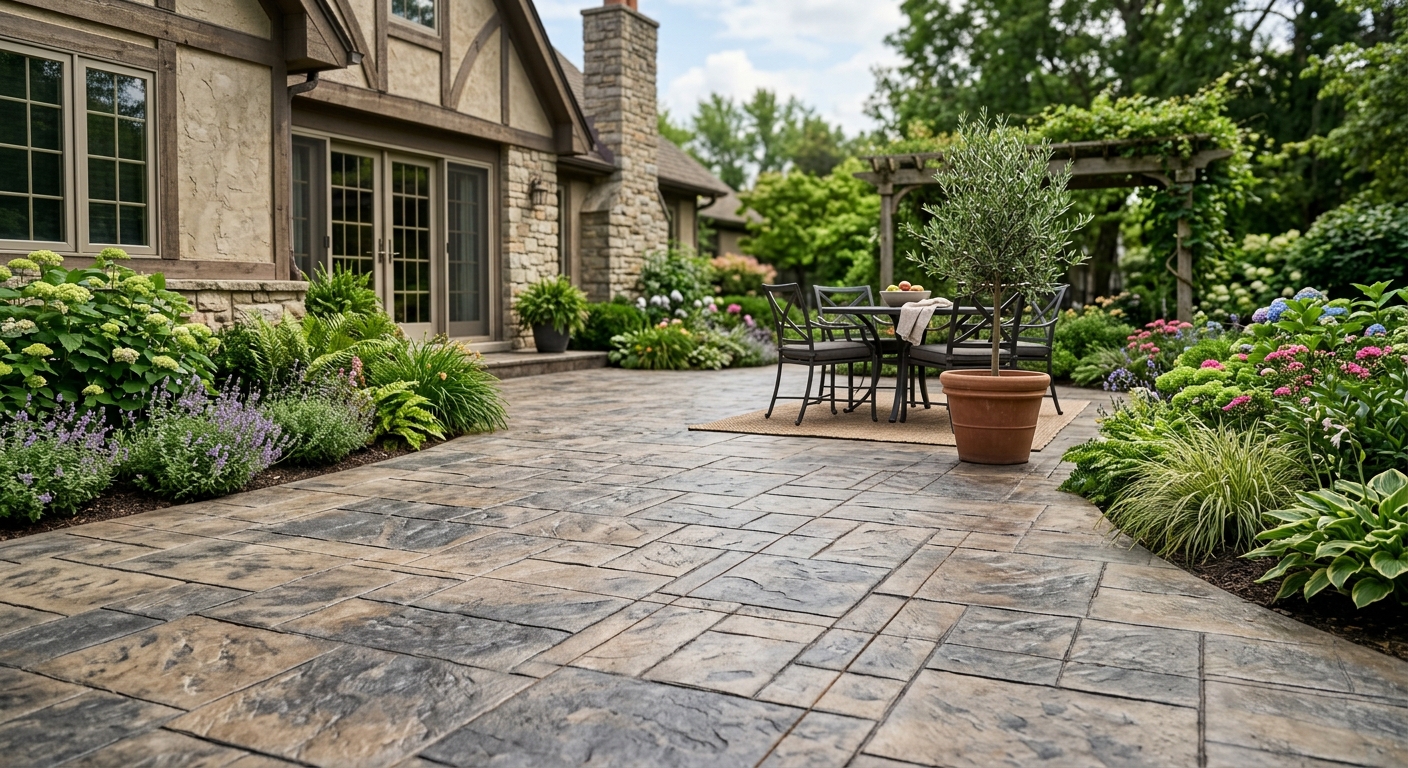
Stamped concrete is a single poured concrete slab that gets textured and colored before it fully cures. Contractors press patterned stamps into the wet surface — replicating the look of natural stone, brick, slate, cobblestone, or even wood — then apply acid stains or integral pigments to achieve realistic color variations.
The result is a seamless, continuous surface that can mimic premium materials at a fraction of the cost. In 2026, advances in stamping technology and UV-stable colorants have dramatically improved how long these finishes hold their appearance — a concern that plagued earlier installations from the 2000s and early 2010s.
What Are Pavers?
Pavers are individual interlocking units — typically made from concrete, natural stone (like travertine, bluestone, or granite), clay brick, or porcelain — that are laid over a compacted gravel and sand base. Unlike stamped concrete, pavers create a modular surface where each unit can theoretically be removed and replaced independently.
The market has expanded significantly. By 2026, large-format porcelain pavers (24″x24″ and larger) have become one of the fastest-growing segments of the outdoor paving industry, prized for their near-zero maintenance and contemporary aesthetic. According to the Interlocking Concrete Pavement Institute (ICPI) 2025 Market Report, paver installations in residential applications grew by 18% between 2023 and 2025, driven largely by porcelain and premium natural stone demand.
Cost Breakdown: What You’ll Actually Pay in 2026
Let’s be direct about money — because nothing derails a great patio project faster than sticker shock mid-installation.
Stamped Concrete Cost Ranges
In 2026, expect to pay $12 to $22 per square foot for professionally installed stamped concrete, depending on your region, pattern complexity, and number of colors. A basic single-color, single-pattern stamped concrete patio runs closer to $12–$15/sq ft. Add multiple colors, intricate borders, or a combination of patterns (a popular 2026 design trend), and you’re looking at $18–$22/sq ft.
For a typical 400 square foot patio, that translates to:
- Basic stamped concrete: $4,800 – $6,000
- Mid-range stamped concrete: $6,400 – $8,000
- Premium stamped concrete: $8,400 – $9,600+
Don’t forget to budget for resealing every 2–3 years, which runs approximately $0.50–$1.25/sq ft as a DIY project or $1.50–$3.00/sq ft professionally.
Paver Cost Ranges
Pavers carry a higher upfront price tag. In 2026, installed costs range widely:
- Concrete pavers: $15 – $25/sq ft installed
- Clay brick pavers: $18 – $28/sq ft installed
- Natural stone pavers (travertine, bluestone): $22 – $40/sq ft installed
- Porcelain pavers (large format): $28 – $50/sq ft installed
For that same 400 sq ft patio with standard concrete pavers, expect $6,000–$10,000. Upgrade to travertine and you’re potentially looking at $12,000–$16,000+. Supply chain stabilization in late 2025 helped moderate material costs slightly, but skilled labor rates in most U.S. markets continue to push installed prices upward in 2026.
Pro Tip: Get a minimum of three detailed quotes that itemize materials, base preparation, labor, and finishing separately. Vague per-square-foot quotes often hide costs related to site grading, tree root removal, or drainage solutions that can add 20–40% to your final bill.
Durability, Longevity, and Climate Considerations
Climate is the single most important factor that gets overlooked in the stamped concrete vs. pavers debate — and it’s where many homeowners make costly mistakes.
How Each Material Handles Freeze-Thaw Cycles
If you live in USDA Hardiness Zones 3–6 (think Minnesota, Michigan, New England, Colorado), freeze-thaw cycling is your material’s biggest enemy. Water infiltrates the surface, freezes, expands, and cracks or heaves the paving material over time.
Stamped concrete is particularly vulnerable here. Because it’s a monolithic slab, when cracking happens (and in freeze-thaw climates, it will eventually happen), the crack runs visibly across the surface. Sealing is essential in these climates but must be maintained religiously. A 2024 study by the Portland Cement Association found that properly sealed stamped concrete in freeze-thaw climates lasted an average of 15–20 years before requiring significant resurfacing.
Pavers perform significantly better in cold climates. The individual units flex and shift with ground movement without cracking. When a paver heaves, you simply re-level and re-sand the affected area. This is a massive long-term advantage in northern climates.
Heat and UV Performance in Warm Climates
In hot, sunny climates (zones 9–12: Arizona, Florida, Southern California, Texas), stamped concrete faces a different challenge: UV fading and surface temperature. Dark-colored stamped concrete can become uncomfortably hot underfoot in summer — sometimes reaching 140–160°F surface temperatures. Color fading without proper UV-stable sealants is also a persistent issue.
Lighter-colored travertine or tumbled limestone pavers naturally reflect more heat and stay cooler. Porcelain pavers with light finishes are increasingly the go-to choice for pool surrounds in warm climates specifically because of this thermal advantage.
Longevity Summary:
- Stamped concrete: 15–25 years with proper maintenance
- Concrete pavers: 25–35 years
- Natural stone pavers: 40–100+ years (many natural stone patios outlast the homes themselves)
- Porcelain pavers: 30–50+ years (relatively newer product with limited long-term field data)
Aesthetics and Design Flexibility
This is where personal vision meets practical reality. Both options offer impressive design range, but they excel in different aesthetic directions.
Stamped concrete shines when you want:
- A seamless, flowing look with no visible joints
- Organic, irregular patterns (flagstone, random stone) that would be labor-intensive to replicate with real pavers
- Integrated color washes that mimic aged, weathered stone
- Custom borders with contrasting colors or patterns in a single pour
- A modern, minimalist aesthetic with large, smooth sections
Pavers excel when you want:
- Authentic material texture and variation (real stone is simply impossible to fully replicate)
- Classic herringbone, basketweave, or running bond patterns
- The ability to create complex curves and radius designs with smaller units
- Mixed material combinations (pavers + grass joints, pavers + gravel, pavers + wood)
- Large-format contemporary looks with minimal grout joints (porcelain pavers)
In 2026, the most popular design trend bridging both worlds is combination installations — a stamped concrete field with a natural stone or paver border, giving homeowners cost savings in the primary area with a premium look at the edges. This hybrid approach has become particularly popular in the Pacific Northwest and Southeast markets.
Maintenance Reality Check
Nobody wants to spend their weekend maintaining a patio. Let’s be honest about what each option demands.
Stamped Concrete Maintenance Requirements
The Achilles heel of stamped concrete is its sealer dependency. Without regular sealing:
- Colors fade, especially in UV-intense environments
- The surface becomes more porous and susceptible to staining
- Freeze-thaw damage accelerates dramatically
- The surface can become slippery when wet (sealers often reduce traction)
Realistically, plan for resealing every 2–3 years as a hard requirement, not a suggestion. The process takes a full weekend: clean the surface thoroughly, allow it to dry completely (24–48 hours in humid climates), and apply two thin coats of penetrating or film-forming sealer. It’s manageable but non-negotiable.
If a crack develops, repair is visible and imperfect. Color-matching repairs are notoriously difficult, particularly as the original finish ages and shifts in hue. This is the primary reason many homeowners eventually grow frustrated with stamped concrete.
Paver Maintenance Requirements
Pavers require less intensive care but have their own maintenance story:
- Weed growth in joints is the most common frustration, though polymeric sand (now widely standard in 2026 installations) dramatically reduces this issue
- Efflorescence — white mineral deposits that leach to the surface — can affect concrete pavers in the first 1–2 years
- Occasional re-leveling if sections settle unevenly, which is quick to address but requires catching it early
- Pressure washing annually keeps them looking fresh, though this is simpler than concrete sealing
Natural stone pavers are more stain-resistant overall but porous varieties (travertine, limestone) benefit from periodic sealing — though less frequently than stamped concrete.
Installation Process and Timeline
Understanding installation helps you plan your project timeline and evaluate contractor quality.
Stamped Concrete Installation Timeline (400 sq ft patio):
- Site preparation and forming: 1 day
- Concrete pour and stamp: 1 day (timing is critical — stamps must be pressed before concrete fully cures)
- Initial color application: same day as pour
- Curing period: 24–48 hours before light foot traffic; 28 days for full cure
- Sealer application: typically 7–14 days post-pour
- Total usable timeline: 2–3 weeks from start to finish
Paver Installation Timeline (400 sq ft patio):
- Excavation and base preparation (6″–8″ compacted gravel): 1–2 days
- Sand bedding layer: half a day
- Paver laying: 1–3 days depending on pattern complexity
- Polymeric sand application and compaction: half a day
- Total usable timeline: 3–7 days, often usable within 24 hours of completion
Key insight: Pavers are typically usable faster, and there’s no lengthy cure period. However, don’t rush base preparation — a poorly compacted base is the #1 cause of paver settling and the #1 reason for warranty disputes.
Side-by-Side Comparison Table
| Metric | Stamped Concrete | Concrete Pavers | Natural Stone Pavers |
|---|---|---|---|
| Avg. Installed Cost (2026) | $12–$22/sq ft | $15–$25/sq ft | $22–$45/sq ft |
| Expected Lifespan | 15–25 years | 25–35 years | 40–100+ years |
| Freeze-Thaw Performance | Fair (vulnerable to cracking) | Excellent (self-adjusting) | Excellent |
| Maintenance Level | Moderate–High (reseal q2–3yr) | Low–Moderate | Low (stone-dependent) |
| Repair Ease | Difficult (color matching) | Easy (individual unit swap) | Easy–Moderate |
Data Visualization: Key Metrics at a Glance
Here’s a visual comparison of key performance scores (rated out of 100) based on aggregated homeowner satisfaction data from the 2025 National Home Improvement Survey:
Long-Term Value
Initial Affordability
Design Versatility
Ease of Maintenance
Source: 2025 National Home Improvement Survey, n=4,200 homeowners. Scores reflect composite ratings for residential patios under 600 sq ft.
Real-World Scenarios: Two Homeowners, Two Choices
Case Study 1: The Anderson Family — Columbus, Ohio
In spring 2025, the Andersons tackled a 480 sq ft backyard patio project with a firm budget of $9,000 all-in. Located in central Ohio (Zone 6a), their freeze-thaw season runs November through March with reliable ground frost.
Their contractor recommended stamped concrete with an ashlar slate pattern and a charcoal-and-tan dual-color treatment. Final installed cost came in at $8,600 — within budget. The patio looked stunning in the first summer. By winter 2025–2026, however, a hairline crack appeared near the corner closest to the downspout — a common pressure point where water concentrates before freezing.
The crack was repaired in spring 2026, but the color match wasn’t perfect. The Andersons now reseal annually (rather than every 2–3 years) as a precaution, adding roughly $200/year in maintenance costs. Their verdict? “Beautiful and we don’t regret it, but we’d probably choose concrete pavers if we were doing it again given our winters.”
Case Study 2: The Morales Family — Scottsdale, Arizona
The Morales family chose tumbled travertine pavers for their 550 sq ft covered patio in early 2026. Cost: $26,400 installed — a significant investment but one they viewed as permanent. In Arizona’s intense UV environment and heat (Zone 10b), travertine’s natural light color keeps surface temperatures manageable and UV fading is essentially a non-issue.
Twenty months post-installation, maintenance has been minimal: one pressure wash session and reapplication of a penetrating stone sealer. One paver near the fire pit sustained a chip from a dropped cast iron grill grate — a contractor replaced the single unit in 45 minutes for $85. Their verdict? “Best outdoor investment we’ve made. It looks exactly the same as day one, and we barely think about it.”
These two stories illustrate a core principle: climate match matters more than aesthetics preference. The Andersons made a reasonable choice for their budget; the Morales family made an optimal choice for their environment.
Common Challenges and How to Overcome Them
Challenge 1: Cracking in Stamped Concrete
This is the #1 complaint among stamped concrete owners. The reality is that concrete cracks — period. The question is whether those cracks are controlled and minimized.
How to overcome it:
- Insist on proper control joint placement every 8–10 feet in each direction (many contractors skip this for aesthetic reasons — don’t allow it)
- Ensure a minimum 4″ slab thickness (5″–6″ for heavy use areas)
- Require fiber reinforcement or rebar in the concrete mix
- Verify a proper compacted gravel sub-base of at least 4″
- Maintain annual sealing in freeze-thaw climates
Challenge 2: Paver Joint Weed Growth and Ant Nesting
The joints between pavers, while a structural advantage, become pathways for weeds and ant colonies if not properly treated. This is the most cited frustration among paver owners in the first 2–5 years.
How to overcome it:
- Specify polymeric sand with joint stabilizers (not regular sand) — this has become the industry standard in 2026 and dramatically reduces both weeds and ant infiltration
- Apply a pre-emergent herbicide to the patio perimeter annually in spring
- Seal concrete pavers with a joint-penetrating sealer that also hardens the sand
- Ensure proper drainage design so joints don’t stay saturated (which accelerates weed germination)
Challenge 3: Finding and Vetting a Qualified Contractor
Both stamped concrete and paver installation are highly skill-dependent. A mediocre contractor with quality materials produces worse results than a great contractor with mid-range materials. In 2026, the labor market for skilled outdoor hardscaping contractors remains tight in most U.S. metros.
How to overcome it:
- For stamped concrete, ask to see at least five completed projects in person (not just photos) — specifically look at the color consistency and joint placement
- For pavers, verify the contractor is ICPI-certified (Interlocking Concrete Pavement Institute) — this credential ensures trained installation technique
- Request a written warranty: minimum 1 year workmanship on stamped concrete, minimum 2 years on paver installation
- Check reviews specifically for projects similar to yours in age (2+ years old) to see how the work has held up over time
- Never pay more than 30% upfront — a standard practice in reputable contracting
Frequently Asked Questions
Does stamped concrete add more home value than pavers?
Not necessarily — and often the reverse is true. According to Remodeling Magazine’s 2025 Cost vs. Value Report, exterior paving improvements with natural stone or quality pavers returned an average of 68–72% of costs at resale, compared to 55–62% for stamped concrete. However, a well-maintained stamped concrete patio absolutely adds value; it simply doesn’t tend to command the same premium as quality pavers. In luxury markets above $700K median home value, pavers — particularly natural stone — are increasingly an expected standard, while stamped concrete may be perceived as an economical alternative.
Can stamped concrete be resurfaced or updated later without full replacement?
Yes, and this is one of stamped concrete’s underappreciated advantages. Concrete resurfacing overlays — applied at roughly $4–$8/sq ft in 2026 — can give aging stamped concrete a completely fresh look, new pattern, and new color without demolition and repour. This option works well if the original slab is structurally sound (no major settling or widespread cracking) but has faded color, a worn seal, or an outdated pattern. Pavers, by contrast, can be individually replaced or completely re-laid with a different pattern, offering different but comparable flexibility.
Which option is better for a sloped backyard?
For significant slopes (greater than 2% grade across the patio footprint), pavers have a meaningful advantage. Individual paver units can be adjusted in height during installation to create a level surface over uneven terrain — a process called “grading in the base” — without the engineering complexity that sloped stamped concrete requires. Stamped concrete on slopes requires precise forming and finishing to avoid pooling, and drainage must be engineered into the slab design. Both options can absolutely work on slopes, but pavers offer more installation flexibility and are generally easier for contractors to execute correctly on challenging terrain.
Building Your Perfect Patio: Your Decision Roadmap
You now have the framework. Let’s compress it into a clear action path that gets you from decision to dream patio without second-guessing.
Step 1: Start with your climate zone. If you’re in a hard freeze-thaw climate (Zone 1–6), pavers are the structurally superior choice for long-term performance. If you’re in a warm, dry climate (Zone 8–12), both options perform excellently, and aesthetics and budget can drive the decision.
Step 2: Audit your 5-year maintenance tolerance honestly. If weekend home maintenance projects feel like a chore, pavers’ lower-intensity upkeep is a quality-of-life advantage that compounds over time. If you’re detail-oriented and enjoy maintaining your home, stamped concrete’s sealing routine is entirely manageable.
Step 3: Define your true budget — including lifecycle costs. Stamped concrete’s lower upfront cost can be deceptive when resealing costs, potential crack repairs, and a 15-20 year replacement timeline are factored in. Run a 20-year total cost of ownership calculation, not just a Day 1 number.
Step 4: Explore the hybrid approach. If budget is tight but you love the look of natural stone, consider stamped concrete for 70% of the field area with a natural stone or quality paver border. This approach delivers premium visual impact at a blended cost.
Step 5: Interview contractors before deciding materials. Sometimes the best contractor in your area specializes in one method. A specialist installer will often produce better results than a generalist attempting the unfamiliar option — even with premium materials.
The broader trend shaping outdoor living in 2026 and beyond is clear: homeowners are investing more meaningfully in outdoor spaces as extensions of their living environment, not afterthoughts. The right patio surface isn’t just a functional floor — it sets the tone for every gathering, morning coffee, and summer evening you’ll spend in that space for decades.
The data favors pavers for longevity and climate resilience; the economics favor stamped concrete for upfront accessibility. Both can be the right answer — but only one is right for your specific combination of climate, budget, lifestyle, and vision.
So here’s the question that cuts through everything else: Are you optimizing for the lowest cost to get started, or the lowest total investment over the life of your home? Your honest answer to that question will tell you everything you need to know.
About the Author
