Sunroom Flooring Ideas: Tile Design Options for Every Budget
Reading time: 12 minutes
You’ve finally built — or inherited — that gorgeous sunroom. Natural light pours in from every angle. The views are stunning. But then you look down, and the floor? It’s either dated, damaged, or just plain wrong for the space. Sound familiar?
Here’s the straight talk: the right tile flooring can make or break your sunroom experience. Get it right, and you’ve created a seamless extension of your living space that feels luxurious year-round. Get it wrong, and you’re dealing with cracked grout, slippery surfaces, and a room that feels disconnected from the rest of your home.
In 2026, sunroom flooring design has evolved dramatically. According to the National Association of Home Builders’ 2025 Remodeling Impact Report, sunroom renovations — particularly flooring upgrades — now deliver an average ROI of 72%, up from 61% just three years ago. Homeowners are investing smarter, choosing materials that balance aesthetics, thermal performance, and long-term durability.
Whether you’re working with a tight $500 budget or a generous $10,000 renovation fund, this guide walks you through every tile option worth considering — with real comparisons, honest tradeoffs, and actionable advice you can use today.
Table of Contents
- Why Tile Is Often the Best Choice for Sunrooms
- The Main Tile Types: What Works and What Doesn’t
- Budget-Tiered Tile Options: From Frugal to Luxurious
- Design Trends Dominating Sunrooms in 2026
- Common Challenges and How to Overcome Them
- Side-by-Side Tile Comparison
- Popularity of Tile Choices in Sunrooms (2026 Data)
- FAQs
- Your Sunroom Flooring Roadmap: Next Steps
Why Tile Is Often the Best Choice for Sunrooms
Sunrooms occupy a unique architectural position — they’re indoors, yet they behave like outdoors. Temperature swings, humidity fluctuations, UV exposure, and foot traffic from garden shoes all conspire against softer flooring materials. Hardwood warps. Carpet traps moisture and mold. Vinyl can discolor under intense sun. Tile, however, thrives in these conditions.
Let’s think about this practically. A homeowner in Phoenix, Arizona, dealing with summer sunroom temperatures that can peak at 95°F inside, needs a floor that won’t buckle, fade, or off-gas under that heat. Tile — particularly porcelain — handles thermal stress without complaint. Meanwhile, a homeowner in Vermont who experiences freeze-thaw cycles needs a tile with low water absorption to prevent cracking. There’s a tile solution for both scenarios, and understanding your climate is the first step in making the right call.
Key advantages of tile in sunroom settings:
- Exceptional durability — most quality tiles last 20–50+ years
- Thermal mass properties help regulate room temperature passively
- Moisture resistance prevents mold and structural damage
- Easy to clean — critical in high-traffic transition spaces
- Wide range of styles, sizes, and price points
- Compatible with radiant floor heating systems
- Strong resale value contribution
According to a 2025 survey by Houzz, 68% of homeowners who renovated sunroom flooring chose tile or stone as their primary material — up from 54% in 2022. The trend is clear: tile is the dominant choice, and for excellent reason.
The Main Tile Types: What Works and What Doesn’t
Porcelain Tile: The Workhorse of Sunroom Flooring
If there’s one tile you can almost always recommend for a sunroom without hesitation, it’s porcelain. Fired at higher temperatures than ceramic, porcelain achieves a water absorption rate of less than 0.5% — making it virtually impervious to moisture damage. It’s harder, denser, and more frost-resistant than its ceramic cousin.
In 2026, large-format porcelain tiles (24″x48″ and even 48″x48″) have become wildly popular in sunrooms because they minimize grout lines and create that seamless, expansive look. Rectified-edge porcelain tiles have made installation more precise than ever, and digital printing technology now allows manufacturers to create porcelain that convincingly mimics marble, wood, slate, and even concrete — often at a fraction of the cost of the real material.
Best for: Four-season sunrooms, high-humidity climates, radiant heating setups, homeowners who want low maintenance
Price range: $2–$15 per square foot (materials only)
Watch out for: Cold underfoot in winter without radiant heat; some cheaper options may show print quality issues up close
Ceramic Tile: The Budget-Friendly Classic
Ceramic tile has earned its reputation as the reliable entry-level option — and in 2026, it’s better than ever. Manufacturing improvements have made modern ceramic tiles more durable and aesthetically sophisticated than those from even five years ago. If your sunroom is a three-season space (not exposed to freezing temperatures), ceramic is a perfectly respectable choice.
The key limitation is water absorption. Ceramic tiles absorb between 3–7% moisture, which means they’re not ideal for outdoor-adjacent spaces where freeze-thaw cycles apply. For a sunroom with climate control and no direct exposure to exterior moisture, however, ceramic performs beautifully and costs significantly less than porcelain.
Best for: Three-season sunrooms in mild climates, budget-conscious renovations, rentals and investment properties
Price range: $0.50–$5 per square foot (materials only)
Watch out for: Freeze-thaw cracking if the space dips below freezing; glazed surfaces can be slippery when wet
Natural Stone: Slate, Travertine, and Limestone
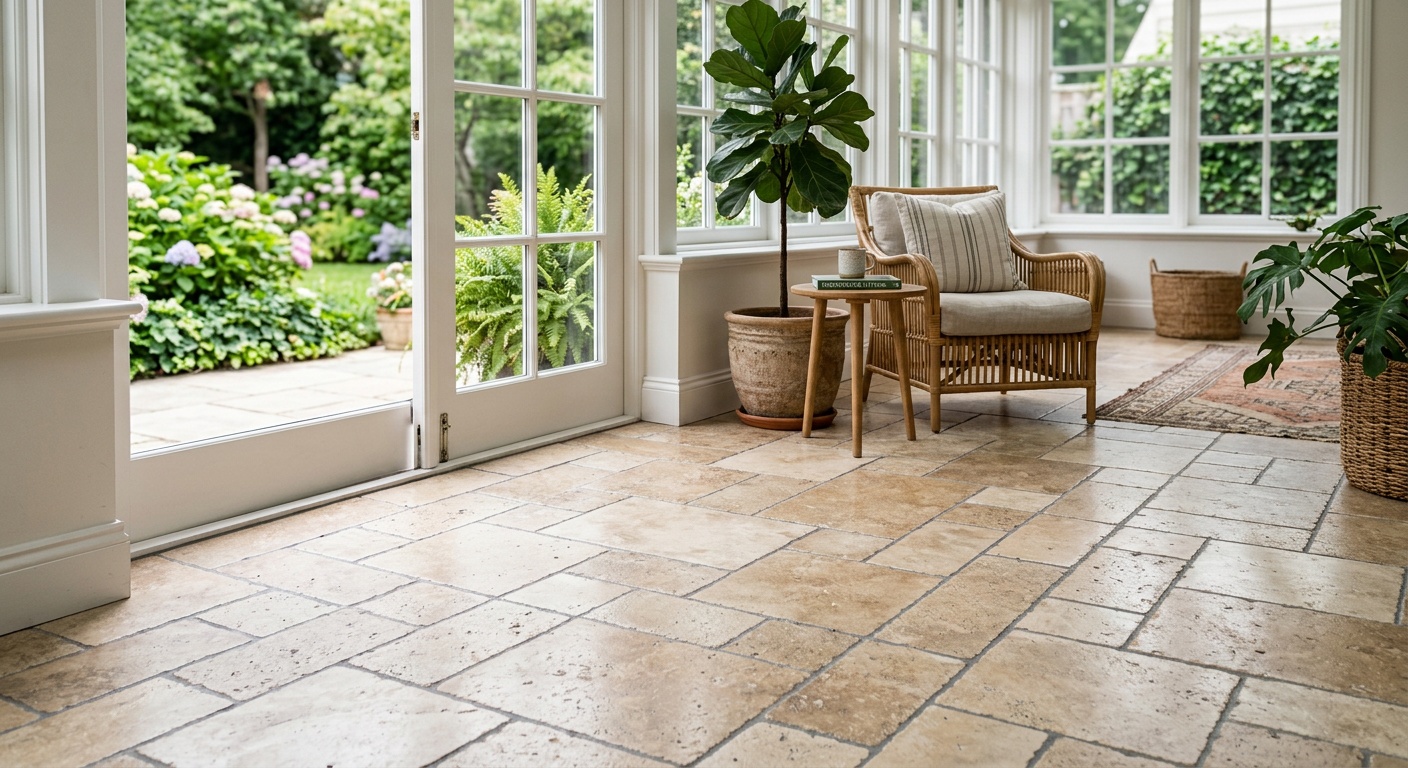
For homeowners pursuing a premium aesthetic — think rustic Mediterranean villa or organic bohemian retreat — natural stone delivers character that no manufactured tile can fully replicate. Each piece is genuinely unique, with natural veining, texture variation, and tonal depth.
Slate is perhaps the most practical natural stone for sunrooms: it’s dense, slip-resistant (particularly in its riven/textured form), and handles temperature variation well. Travertine offers a warm, earthy elegance but requires sealing every 1–3 years to protect its porous surface. Limestone is beautiful but the softest option, making it more vulnerable to scratching and staining.
Best for: Luxury sunrooms, design-forward homeowners, spaces that connect to outdoor patios for visual continuity
Price range: $5–$30+ per square foot (materials only)
Watch out for: Ongoing maintenance requirements; uneven surfaces on some stone types can be tricky for furniture placement
Encaustic and Cement Tiles: The Statement Option
If you’ve scrolled through interior design feeds in 2025 or 2026, you’ve seen encaustic cement tiles everywhere. These handcrafted, pigmented tiles — often featuring bold geometric or floral patterns — add incredible personality to a sunroom. They’re not glazed, which gives them a matte, artisanal finish that photographs beautifully and ages gracefully.
The honest caveat: cement tiles require sealing before installation and regular re-sealing, and they’re not ideal for ultra-high-traffic areas. But as an accent border, a focal point section, or the entire floor of a smaller sunroom, they’re genuinely transformative.
Best for: Design enthusiasts, smaller sunrooms, accent areas, Moroccan or Mediterranean-inspired aesthetics
Price range: $8–$25 per square foot (materials only)
Watch out for: High maintenance; must be sealed properly to prevent staining
Budget-Tiered Tile Options: From Frugal to Luxurious
Let’s get practical. Budget determines a lot — but it doesn’t determine everything. Here’s how to get the most from your specific spending power.
Budget Tier: Under $1,500 (Small Sunroom, Materials + Basic Installation)
Working with a tight budget? You’re not out of options. Standard ceramic floor tile in sizes 12″x12″ or 12″x24″ can be found at big-box retailers like Home Depot or Lowe’s for as little as $0.69–$2.50 per square foot. For a 150-square-foot sunroom, that’s $100–$375 in materials, leaving room for grout, adhesive, and basic installation costs.
Smart strategies at this budget:
- Choose a simple grid pattern to minimize cutting and labor costs
- Opt for rectified tiles to reduce grout joint width (sleeker look, less grout to maintain)
- Look for discontinued tile lots at tile specialty stores — often 40–60% off
- Consider DIY installation if you’re handy — ceramic tile is among the most forgiving for first-timers
Quick scenario: Maria, a teacher in Columbus, Ohio, renovated her 120-square-foot sunroom in early 2026 with clearance 16″x16″ ceramic tile from a local tile outlet. Total materials cost: $180. She hired a local handyman for installation, bringing her total to $820. The result looks clean, professional, and adds functional value to her home — proof that budget doesn’t mean boring.
Mid-Range Tier: $1,500–$5,000
This is the sweet spot where design options open up significantly. At this budget, you can afford quality porcelain tile, larger format options, and professional installation with a skilled crew. Wood-look porcelain planks — one of the most popular sunroom flooring trends in 2026 — typically run $3–$8 per square foot and deliver warmth without wood’s vulnerabilities.
Smart strategies at this budget:
- Invest in large-format porcelain (24″x24″ or larger) for a high-end appearance
- Consider wood-look planks in warm oak or gray ash tones — extremely popular in 2026
- Allocate 15–20% of your budget to professional layout design (diagonal or herringbone patterns add visual drama)
- Budget for heated floor mat installation — a mid-range addition that transforms four-season comfort
Premium Tier: $5,000–$10,000+
At this level, you’re selecting from the full catalog: large-format Italian porcelain slabs, natural marble-look tiles, handcrafted cement tile patterns, or genuine slate and travertine. Installation quality matters enormously here — skilled tile setters who specialize in premium materials are worth every penny.
Case study: A couple in Scottsdale, Arizona, redesigned their 300-square-foot sunroom in 2025 using 24″x48″ honed travertine-look porcelain from a Spanish manufacturer (approximately $9 per square foot), installed in a running bond pattern with 1/16″ grout joints. Combined with in-floor radiant heating and custom transition trim, the total project cost came to $8,400. The result was so seamless with their adjacent patio’s real travertine that guests couldn’t identify where one flooring ended and the other began — and their home’s appraised value increased by an estimated $14,000.
Design Trends Dominating Sunrooms in 2026
Design doesn’t exist in a vacuum — and the best sunroom floors in 2026 reflect broader interior design movements that emphasize biophilic connection, sustainability, and textural richness.
Top tile design trends to watch:
- Organic earth tones: Warm terracottas, sandy beiges, sage greens, and deep umber tones dominate 2026 sunroom palettes — moving decisively away from the cool grays that dominated the 2018–2023 era
- Oversized formats with minimal grout: The “slab” aesthetic continues, with homeowners choosing fewer, larger tiles to maximize visual simplicity
- Textured finishes: Lappato (semi-polished), bush-hammered, and wood-grain surface textures add tactile interest and reduce slip risks
- Indoor-outdoor continuity: Tiles that bridge interior sunrooms with exterior patios — same tile or coordinated family — create architectural flow
- Checkerboard returns: Black-and-white or two-tone checkerboard patterns have made a strong comeback, particularly in farmhouse and cottage-style sunrooms
- Zellige-inspired tiles: Handmade Moroccan-style zellige ceramics with their characteristic irregular surface and rich glazes add artisanal warmth
Common Challenges and How to Overcome Them
Even with the best tile selected, sunroom flooring projects come with specific challenges. Here are the three most common — and how smart homeowners solve them.
Challenge 1: Cold Floors in Winter
Tile is thermally honest — it reflects the temperature of the air around it. In a four-season sunroom during winter, this can mean uncomfortably cold floors. The solution is radiant floor heating, either electric mat systems (easiest to retrofit, $8–$15 per square foot installed) or hydronic systems (more efficient for larger areas, $15–$25 per square foot installed). In 2026, electric radiant mat systems have become significantly more energy-efficient, with smart thermostats that learn usage patterns and cut energy costs by up to 30% compared to older systems.
Challenge 2: Expansion and Contraction
Sunrooms experience more dramatic temperature swings than interior rooms. Without proper expansion joints, tiles can pop, crack, or de-bond from the substrate. The fix: ensure your installer uses appropriate movement joints every 8–10 feet and at all transitions — and choose a high-quality flexible tile adhesive rated for exterior or sunroom applications. This is not the place to cut corners on installation quality.
Challenge 3: Choosing the Right Slip Resistance
Sunrooms are transition spaces — people walk in from wet gardens, pools, or rain-soaked decks. Slippery tile is a genuine safety hazard. Look for tiles with a COF (Coefficient of Friction) rating of at least 0.60 for residential spaces. Matte, textured, and lappato finishes generally outperform polished tiles in wet conditions. When in doubt, ask your tile supplier for the DCOF (Dynamic Coefficient of Friction) rating — the current industry standard in 2026.
Side-by-Side Tile Comparison
| Tile Type | Cost ($/sq ft) | Durability | Maintenance | Best Climate |
|---|---|---|---|---|
| Porcelain | $2–$15 | ⭐⭐⭐⭐⭐ | Very Low | All climates |
| Ceramic | $0.50–$5 | ⭐⭐⭐ | Low | Mild, 3-season |
| Natural Stone | $5–$30+ | ⭐⭐⭐⭐ | Medium–High | Varies by stone |
| Cement/Encaustic | $8–$25 | ⭐⭐⭐ | High | Temperate, dry |
| Slate | $7–$20 | ⭐⭐⭐⭐⭐ | Low–Medium | All climates |
Popularity of Tile Choices in Sunrooms (2026 Data)
Based on aggregated 2025–2026 renovation data from Houzz, HomeAdvisor, and the Tile Council of North America:
Porcelain Tile
Ceramic Tile
Natural Stone
Cement / Encaustic
Slate
*Respondents could select multiple options. Percentages reflect share of renovations including each tile type.
Frequently Asked Questions
Q1: Is tile flooring too cold for a year-round sunroom?
It can be, but it doesn’t have to be. Tile’s thermal mass actually works in your favor in a well-designed four-season sunroom — it absorbs daytime solar heat and releases it slowly in the evening. For colder climates or winter-heavy use, pairing tile with an electric radiant heating mat virtually eliminates the cold-floor problem. Modern smart thermostats for radiant systems (like Nuheat’s 2025 model or Schluter’s DITRA-HEAT-E-WiFi system) can pre-warm your floor before you even step in, using minimal energy. The honest answer: with radiant heat, a tiled sunroom floor can actually feel warmer and more inviting than a carpeted room in winter.
Q2: Can I install sunroom tile directly over my existing concrete slab?
In many cases, yes — but the condition of your slab matters enormously. Before installing tile over a concrete slab, you need to verify: (1) the slab is structurally sound and not actively cracking or settling; (2) moisture vapor transmission levels are within acceptable range (a simple calcium chloride test can confirm this); and (3) the surface is flat to within 3/16″ over a 10-foot span, per the TCNA (Tile Council of North America) 2026 Handbook guidelines. If your slab has minor cracks or imperfections, uncoupling membranes like Schluter DITRA provide an excellent intermediary layer that both levels the surface and prevents crack transmission into your tile layer. Don’t skip this assessment step — a failed tile job because of slab issues is far more expensive to fix than preparing the substrate correctly from the start.
Q3: What’s the best tile grout color for a bright, sunlit space?
Grout color is genuinely underappreciated in sunroom design — and in a sun-drenched space, it becomes even more visible than in interior rooms. As a general principle: lighter grout (white, cream, ivory) expands the visual sense of space and works beautifully with light-colored tiles but requires more frequent cleaning. Medium tones (greige, warm gray, mocha) are the most forgiving and work across a wide range of tile colors. Dark grout (charcoal, black) creates dramatic visual definition — especially striking with the checkerboard revival trend of 2026 — but can fade or look uneven if not sealed properly. One underrated tip: in a sunroom, UV exposure can cause certain grout pigments to fade over time. Choose a premium epoxy grout or a UV-stable cement grout with a quality sealer to maintain consistent color for years.
Your Sunroom Flooring Roadmap: Next Steps
You now have the framework to make a confident, informed decision about your sunroom tile flooring. Here’s your practical action plan to move from inspiration to installation:
- Assess your sunroom’s conditions first. Is it three-season or four-season? What are your local climate extremes? Does the space connect to an outdoor patio? These answers narrow your tile category before you look at a single product.
- Set a realistic total budget — not just a materials budget. As a rough guide, installation typically costs 60–100% of your materials cost. A $4 tile doesn’t cost $4 per square foot installed — it costs $7–$8. Plan accordingly.
- Order samples before committing. Tile looks dramatically different in a showroom under artificial lighting versus your sunroom under natural light. Request 4–6 samples and live with them for a few days at different times of day.
- Vet your installer as carefully as your tile. Ask to see completed sunroom-specific projects, verify they know TCNA installation guidelines, and confirm they understand expansion joint requirements for temperature-variable spaces.
- Consider radiant heat as a baseline, not an upgrade. If you’re doing this renovation once, adding in-floor heating during installation is far cheaper than retrofitting it later. It fundamentally transforms how the space feels and functions.
The broader context matters here: as remote work continues normalizing home investment, and as biophilic design principles cement their place in residential architecture through 2026 and beyond, sunrooms are evolving from “bonus room” to genuine living space extension. The floor you choose today sets the foundation — literally and aesthetically — for how your family experiences that space for the next two or three decades.
So here’s the question only you can answer: what kind of sunroom experience do you want to wake up to every morning? Start there, let that vision guide your material choices, and use this guide to execute it smartly — at whatever budget you’re working with. Your perfect sunroom floor isn’t out of reach. It’s just a few well-informed decisions away.
About the Author
